RobotX 2026
One boat, fourth out of 22 teams.
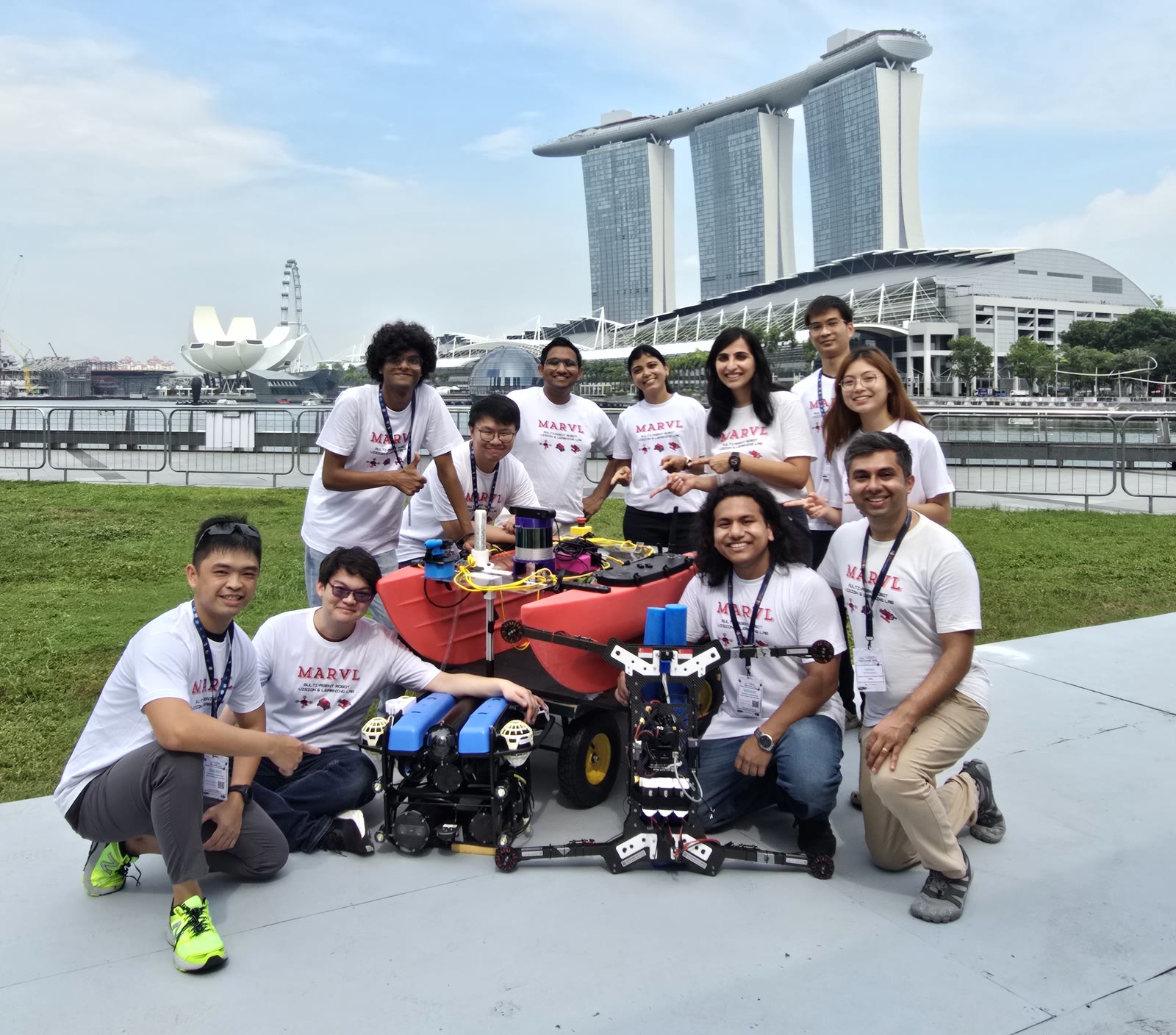
The Maritime RobotX Challenge is a competition for autonomous boats, drones and underwater robots, run by RoboNation. The 2026 edition was at Marina Bay in Singapore, from 8 to 14 November. Our team, MARVL from SUTD, went in with only our BlueBoat USV and ended up 4th overall out of 22 teams, and 2nd among the teams from Singapore. I co-led the team with A Manicka Praveen, and Prof. Malika Meghjani was our advisor.
The tasks§
This year’s scenario was a storm response at a coastal port, split into four tasks. Most of them are meant for more than one vehicle, so we had planned for three: the BlueBoat on the surface, a BlueROV2 underwater and a quadrotor in the air. The pool we test in closed for the year, and the quadrotor missed its qualification by a few hours. So only the boat went to the course.
We picked the parts of the tasks that a boat can do alone:
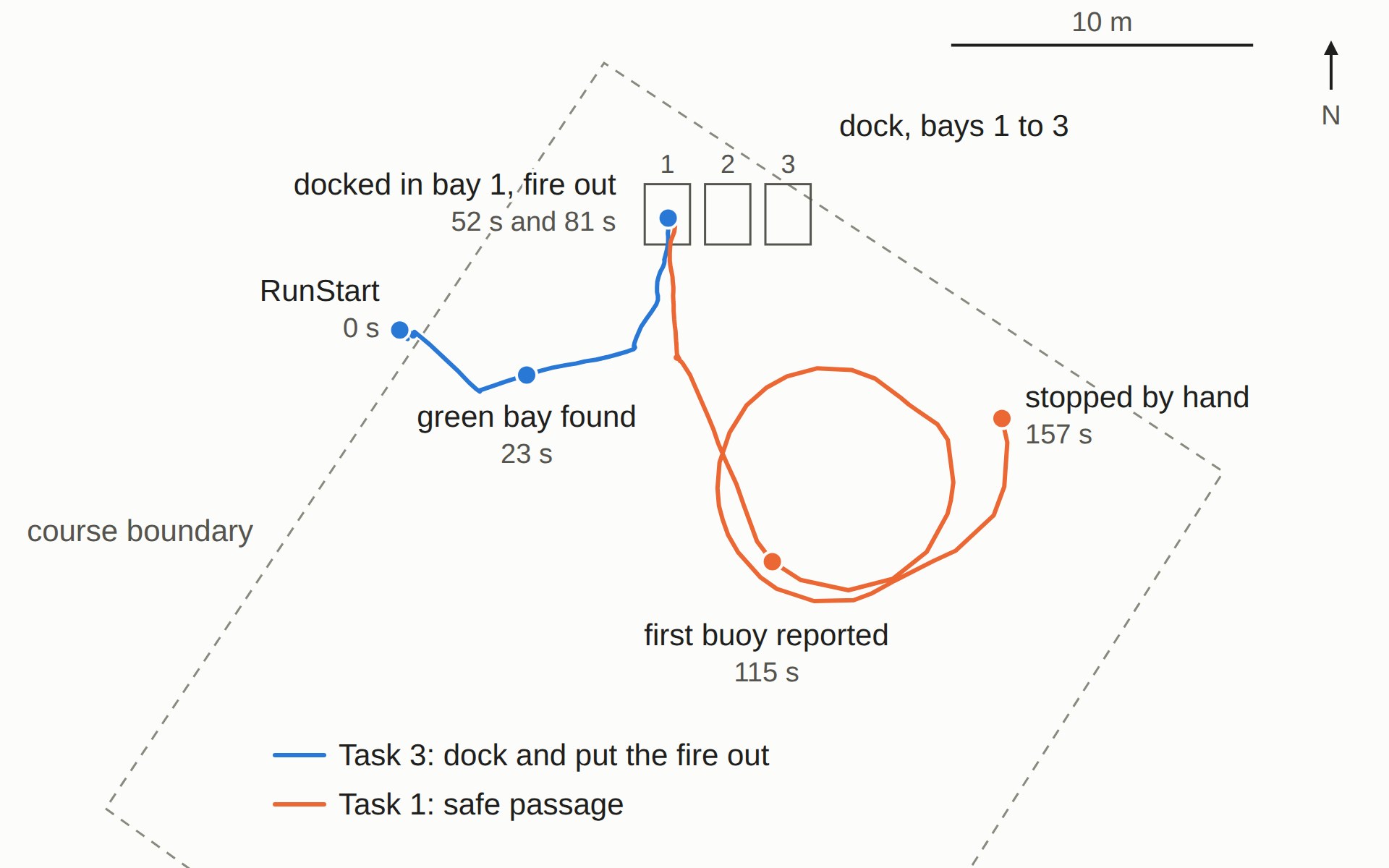
- Task 1, safe passage. Find the buoys that carry lights, circle the entry buoy, cross the field with the red lights to starboard and the green ones to port, then circle the exit buoy.
- Task 3, coordinated logistics. Find the dock, read which of its three bays shows a green light, dock there, and put out a fire (a lit window at the back of the bay) with a water cannon.
- Task 4, dynamic incident response. During a run the judges’ system can send alerts about a moving object crossing the course. The boat has to acknowledge them and stay out of the object’s way.
Every task has three tiers: Core, Advanced and Disruptive. We went for Task 3 Core, Task 1 Core and Task 4 Disruptive. Task 2 is the underwater one, so we left it out.
The week§
First we had to pass safety validation at the event. The boat went through the physical safety checks, such as the kill switch and the status light. Our software had to pass a test against RoboCommand, the judges’ system that starts every run and receives every report from the vehicles.
We were ranked 5th in design documentation (the technical report, the team website and the video we sent in before the event). That gave us a chance to book our slots on the water early.
Then came the scoring rounds. At the end of them we were the top wildcard team, the next one after the top four. A wildcard team could still become a finalist by scoring 600 points in a qualifier.
We passed the qualifier, after some drama. In one run we missed the moving obstacle by 5 metres, and the judges had to review that run again properly before we knew the result.
After that we had a great run in our finals slot, with parts of all three tasks in it, and finished 4th out of 22.
How the boat works§
The boat is a Blue Robotics BlueBoat running ArduRover. It carries a Jetson Orin NX, a ZED 2 stereo camera, a RoboSense lidar, and a water cannon on two servos with a pump.
All of our code on the boat runs as one program, which we call the console. It talks to ArduRover over MAVLink, keeps a map of what the sensors see, runs the tasks and serves web pages. We open those pages on a laptop on shore to start a run and to see what the boat sees. A small second program on the laptop, the bridge, passes messages between the boat and RoboCommand.
- Seeing. The camera says what a thing is and what colour its light is. The lidar says where it is. Minh-Long Pham trained the detection models, and trained them again during the week on images from the course. They run as TensorRT engines on the Jetson, which took the buoy model from 374 ms a frame to 99 ms. The lidar finds buoys by their size and finds the dock by fitting its piers.
- Planning. A grid planner (A*) finds a way through the map and keeps a clearance around every buoy. Before each move, a guard checks the boat’s path against the lidar’s own points, and turns, slows or stops the boat if something is there.
- Task 3. The boat finds the dock with the lidar, lines up in front of it, reads the three bay lights until one is clearly green, docks and sends its docking report. Then it sprays. The cannon fires in bursts of 5 seconds on and 5 seconds off, because the camera can only read the window while the water is off. Kaustubh Singh worked out the maths for aiming the jet.
- Task 1. The boat reads each buoy’s light from a still position, finds the entry and exit buoys, and plans the crossing between the red and green ones.
- Task 4. A moving object goes on the map as a long shape, from where it is now to where it will be in 20 seconds. Every planner treats that shape as a wall.
- Simulation. At home we ran the same console against ArduRover’s simulator and RoboNation’s own test server. We rehearsed a whole run there before trying it on the water. The code also has about 950 automated tests.
What we fixed during the week§
Most fixes came from reading the logs of the last slot before the next one. A few of them:
- People in orange vests and red flags on the pontoon behind the buoys were read as red lights. One recording had 796 red reads. We changed the boat to read a light only at the top of a buoy and to reject orange. That left 169, nearly all of them real.
- The boat docked in a red bay more than once. Its check on the way into the green bay said the bay was blocked, so it went to the middle bay. We fixed the check the same day.
- Only one task’s models fit on the Jetson’s GPU at a time, and the buoy model takes about half a minute to load. The boat now starts loading it while it is still backing out of the dock.
- In the finals slot, alerts for the moving object came about twice a second, and the boat acknowledged each one more than once. The bridge sends two messages a second, so our docking report waited behind the acknowledgements and left minutes late. Between two runs we changed the boat to acknowledge the first alert and then one every 5 seconds. In the next run the docking report went out a second after docking. That is the run in the figure above.
Thanks§
Prof. Malika summed up our week in one word: grit. I agree with her.
Thank you to my co-lead A Manicka Praveen. Divyesh Saraf had an answer to every technical problem we brought him. Minh-Long Pham did the computer vision, and Kaustubh Singh the maths for the water cannon. Jun Jie Hoo, Christopher Quah and Chester Chen looked after the hardware. Sefomi led the props, and Marc Choo and Surya led the UAV. Thank you to Prof. Malika Meghjani for advising us, and to RoboNation, the judges, the sponsors and the partners for running the event.
The team’s website, with the vehicles and the rest of our design, is at marvl-research-lab.github.io/robotx2026.